
“Retired Westie” means two very different dogs, and the difference matters enormously to whoever adopts one.
Some people mean an elderly dog winding down. Most mean a dog leaving a commercial breeding operation after its productive years. The second group needs something quite specific, and this page is mostly about them.
The short version
- A retired breeding dog is usually four to eight years old — not elderly.
- Most have never lived in a house, climbed stairs, or walked on a lead.
- Progress is measured in months, and it is rarely a straight line.
- They are among the most rewarding dogs in rescue, and among the least suited to a busy first-time household.

The two kinds of “retired”
| Retired breeding dog | Elderly companion dog | |
|---|---|---|
| Typical age | 4–8 years | 10–15 years |
| Life so far | Kennel or barn, minimal handling | Lived in a family home |
| House training | Usually none | Established |
| Lead walking | Often never experienced | Familiar |
| Confidence with people | Low, sometimes very low | Usually good |
| Common medical needs | Dental disease, skin, untreated conditions | Age-related: joints, heart, kidneys |
| Main challenge | Fear and unfamiliarity | Medical management |
| Settling time | 6–18 months | Weeks |
If it is the elderly dog you are drawn to, the case for adopting a senior dog makes that argument properly.
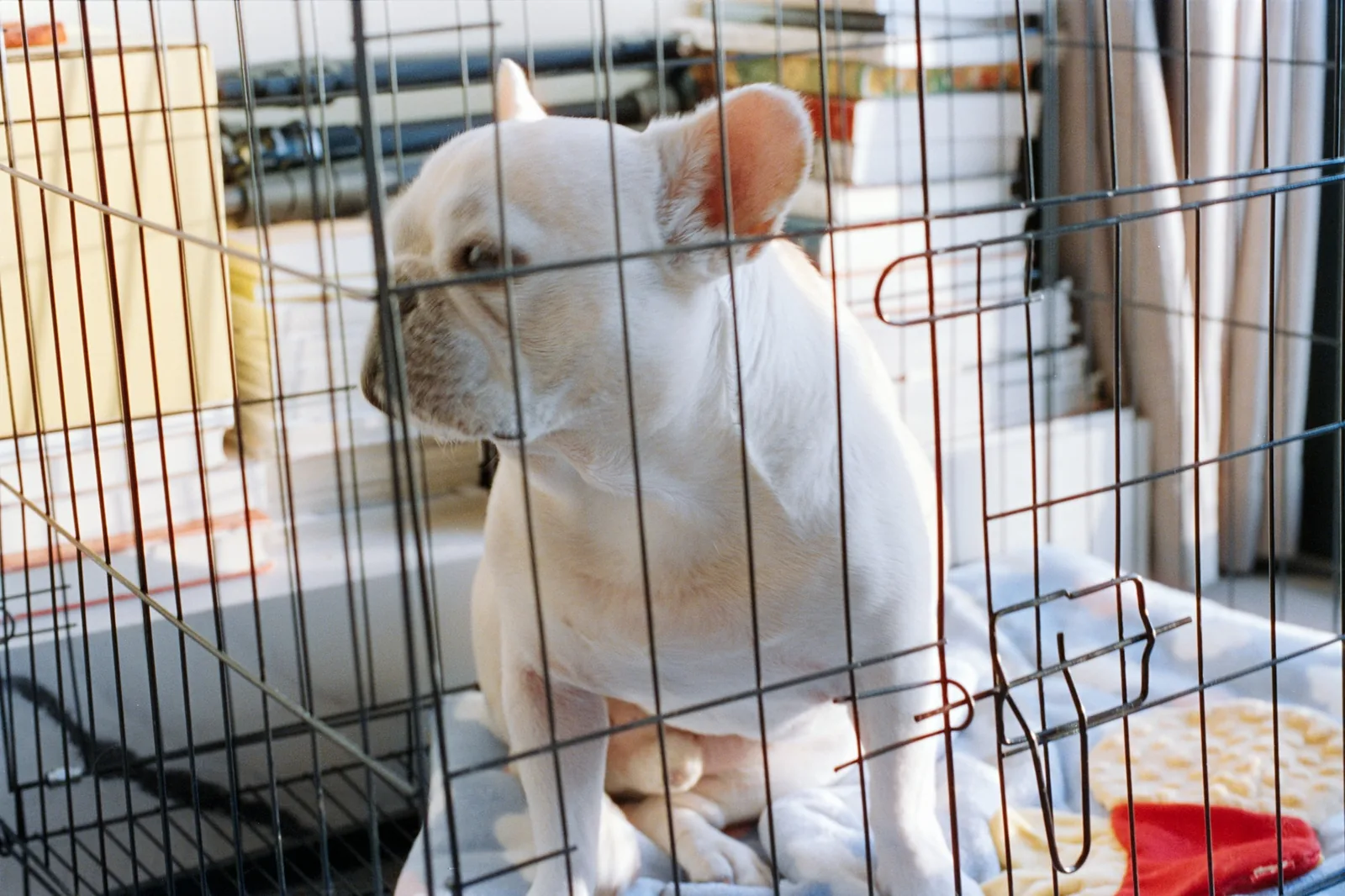
What a breeding kennel does to a dog
Dogs in commercial breeding spend years in a run with minimal handling. They are fed, watered and bred, and very little else happens to them.
The result is not usually an aggressive dog. It is a dog with no reference points — one that has never heard a washing machine, felt carpet, or had a person kneel down to say hello.
Common patterns on arrival include freezing when approached, retreating to corners, pacing or circling, and no response at all to a name.
The first year, month by month
These timelines come from how these dogs typically progress. Individual dogs move faster or slower, and setbacks are normal rather than a sign of failure.
| Stage | What you will see | What helps most |
|---|---|---|
| Days 1–3 | Shutdown, hiding, refusing food, no eye contact | A quiet covered bed and almost no interaction |
| Weeks 1–2 | Eating when alone, watching from a distance | Predictable routine; sit nearby without approaching |
| Weeks 3–6 | Approaching on their own terms, first tail movement | Let the dog initiate every contact |
| Months 2–3 | House training progressing, walking short distances | Harness rather than collar; a confident resident dog if you have one |
| Months 4–6 | Recognizable personality, play appears | Gentle widening of the world, one new thing at a time |
| Months 6–12 | Confident at home, still wary of strangers | Consistency; resist the urge to test progress |

What these dogs need from a home
- Patience measured in months. The single biggest predictor of success.
- A quiet household. Constant visitors and young children make decompression much harder.
- Secure fencing. A frightened dog that bolts has no recall to fall back on.
- Another steady dog, ideally. Many retired breeding dogs learn from watching a confident housemate faster than from any human.
- Tolerance for slow house training. A dog that has only ever eliminated where it sleeps needs to unlearn that first.
- Willingness to let the dog set the pace. Reaching for a dog that is not ready sets progress back weeks.
Best Friends Animal Society publishes detailed guidance on what to expect when rescuing a puppy mill dog, which is the most realistic account we have found of the early weeks.

What you get in return
Adopters of these dogs describe the same thing: a bond that arrives late and then does not loosen.
The first time a dog that has never solicited attention crosses a room to lean against you is not a small moment. People who have adopted several dogs routinely say it is the one they remember.
You can read what settled life looks like for dogs we have placed on our Westie adoption success stories page.

How we prepare these dogs before placement
No retired breeding dog goes straight from intake to a home. They spend extended time in foster care while the basics are established.
- Full veterinary work-up. Dental disease is near-universal and is usually the first thing addressed.
- Spay or neuter and any outstanding surgical needs.
- Foster placement with an experienced carer who reports weekly on progress.
- Honest behavioral notes shared in full before you meet the dog.
The veterinary care every rescue Westie receives sets out that work in detail, and fostering for a Westie rescue is where much of it actually happens.
Frequently asked questions
What does a retired Westie mean?
Usually a dog retired from a commercial breeding program, typically four to eight years old. Some people use it for elderly dogs instead, so it is always worth asking which a listing means.
Are retired breeding dogs house trained?
Rarely. Most have only ever lived in a kennel and need house training from the start, which commonly takes two to three months.
Are they good with children?
Usually not as a first home. Sudden movement and noise are exactly what these dogs find hardest, so quieter households are matched first.
How long until a retired breeding dog settles?
Six to eighteen months to be fully comfortable at home. Meaningful progress usually appears within the first six to eight weeks.
Do they cost more to adopt?
The fee is generally the same, though these dogs almost always need extensive dental work first. Our adoption fees page explains what a fee covers.
If this sounds like the dog for you
These placements work best with adopters who want the project rather than the dog that is already easy. If that is you, our guide to adopting a Westie in New England explains the process, and the Westies currently available for adoption shows who is with us now.
If you are weighing this against a younger dog, what Westie rescues actually have compared with puppies sets the options side by side.