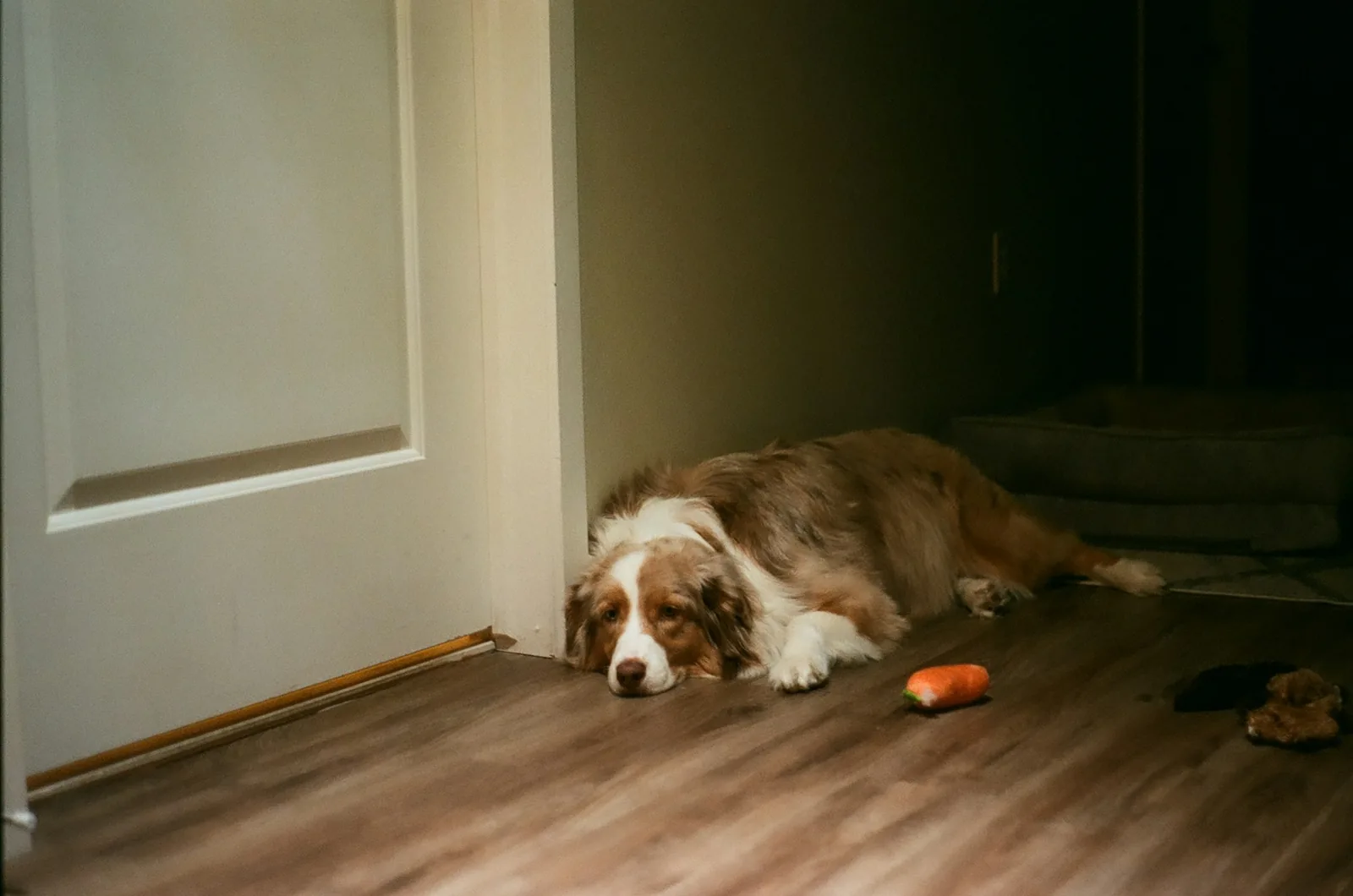
Westies were developed to work alongside a handler, not to spend nine hours alone. Difficulty with isolation is common in the breed, not a character flaw.
But not every dog that barks when you leave has separation anxiety, and that distinction decides whether treatment works.
The short version
- Film the dog. You cannot treat what you have not actually seen.
- True separation anxiety is panic. Boredom looks similar and needs the opposite approach.
- Punishment makes panic worse, without exception.
- Expect weeks to months. Rushing the plan is the usual reason it fails.

Three different problems that look the same
The wrong diagnosis means months of effort aimed at the wrong target.
| Separation anxiety | Boredom | Confinement distress | |
|---|---|---|---|
| When it starts | Within minutes of you leaving | After an hour or more | On being shut in, even with you home |
| What you see on camera | Pacing, drooling, panting, door scratching | Sleeping, then finding something to destroy | Frantic escape attempts at the barrier |
| Damage location | Exit points — doors, windows, frames | Anywhere interesting | The crate or gate itself |
| Vocalizing | Sustained howling and whining | Intermittent barking at noises | Continuous while confined |
| Toileting | Common, even in a house-trained dog | Rare | Common |
| Eats a stuffed toy when alone | No — too distressed | Yes, enthusiastically | No |
| What actually helps | Graduated desensitization | Exercise and enrichment | Change the confinement, not the absence |
If the picture is really boredom, our guide to terrier barking, digging and prey drive is the right starting point instead — the fix there is mental work, not departure training.
Film it before you do anything
Almost every owner is surprised by the footage.
- Set a phone or camera covering the room the dog settles in and the door you leave by.
- Leave normally, without a long goodbye, and stay out for thirty minutes.
- Watch the first ten minutes closely. That is where the answer is.
- Note the timestamp at which the dog settles, if it does. That number is your starting point for training.
Rule out medical causes too. House soiling only when alone can be anxiety or a urinary problem — the causes worth excluding first are set out separately.
The method that works
Graduated desensitization is slow, and the only approach with a good evidence base. The principle: never leave the dog longer than it can currently cope with, because every panic episode sets progress back.
| Stage | What you practice | Move on when |
|---|---|---|
| 1. Cue neutrality | Pick up keys, put on a coat, then sit back down | The dog stops reacting to the cues |
| 2. Door, no exit | Open the door, close it, stay inside | No reaction across several repetitions |
| 3. Seconds | Step outside, return in 5–10 seconds | Calm on your return, every time |
| 4. Minutes | Build in small increments, varying the length | Comfortable at 20–30 minutes |
| 5. Longer absences | Increase in 5–15 minute steps | Settled for 90 minutes |
| 6. Normal life | Ordinary absences of several hours | Most dogs able to cope with a working day |
Vary the durations rather than always increasing them.

What helps alongside the plan
- Exercise before departure, ideally sniffing-based rather than physical.
- A food toy as you leave, which doubles as a daily test of progress.
- Undramatic departures and returns. Long goodbyes raise the stakes.
- Background sound masking the noises that trigger alerting.
- A consistent safe space the dog chose, not one you assigned.
- Daycare, a sitter or a neighbor during training, so the dog is never left beyond its threshold.
That last point is the one people skip, and every over-long absence undoes several sessions. What is normal in a brand-new adoption is covered in the first 30 days with a rescue Westie.
What does not help
| Approach | Why it fails |
|---|---|
| Punishment on return | The dog associates your arrival with anger, raising anxiety |
| Getting a second dog | Attachment is usually to you specifically; often produces two anxious dogs |
| Bark collars | Suppresses the symptom and increases the underlying panic |
| Flooding — leaving longer to “get used to it” | Repeated panic sensitizes rather than habituates |
| Ignoring the dog entirely at home | Old advice, no good evidence, and unkind |
| A crate, for a dog with confinement distress | Adds a second trigger to the first |
The University of Wisconsin School of Veterinary Medicine is one of several academic centers offering behavior referrals, if you want that rather than a trainer.
When medication is appropriate
Medication is not an admission of failure. A panicking dog cannot learn, so reducing panic to a level where new associations can form is the point.
This is a conversation for your vet. Over-the-counter calming supplements have a much weaker evidence base.

Newly adopted dogs are a special case
A dog in its first two weeks will often follow you room to room and protest when you leave. That is usually not anxiety but a dog that has lost everything familiar twice, and most of it resolves as the routine becomes predictable.
Start short absences early. A month of constant company followed by a full working day is how genuine anxiety gets created.

Frequently asked questions
How do I know if my Westie has separation anxiety or is just bored?
Film it. Anxiety starts within minutes and shows as pacing, drooling, panting and damage at exit points. Boredom starts later and the dog will happily eat a stuffed food toy, which a panicking dog will not touch.
How long does it take to treat separation anxiety?
Commonly a few weeks to a few months, depending on severity and how consistently the plan is followed. The most common reason it fails is leaving the dog beyond its threshold during training.
Will getting another dog help?
Usually not. Separation anxiety is normally attachment to a specific person, so a second dog does not substitute and may simply become anxious too.
Can Westies be left alone all day?
Most cope poorly with routine nine-hour absences. Long isolation is a common trigger for barking, digging and destruction.
Is medication necessary for separation anxiety?
Not always, but for severe cases it often makes the behavior work possible, because a panicking dog cannot learn. It is usually temporary and should be discussed with your vet.
If it is not improving
Severe separation anxiety is one of the harder behavior problems and a legitimate reason to get professional help. It is also a common reason dogs are given up.
If you are reaching that point, our guide to your options opens with the problems that turn out to be solvable, and the surrender and rehoming page is where to reach us. Any dog on our adoptable dogs page comes with an honest note on how it copes alone.